It is not easy, if you don't work every day with cars, to understand what is the meaning of all the data coming from OBD2.
One of the functionalities I wanted to add is to be able to calculate the gasoline consumption for each trip.
Until now, I have not found a measurement coming from OBD2 directly connected to this consumption.
What I have found, and I'm able to read, is MAF, that is the quantity of air consumed, per second.
The gasoline is proportional and therefore MAF is an indirect measure of gasoline consumed.
I have also added to my prototype several other data.
This is the JSON message at this point:
Showing posts with label iot. Show all posts
Showing posts with label iot. Show all posts
Sunday, January 28, 2018

Thursday, January 11, 2018
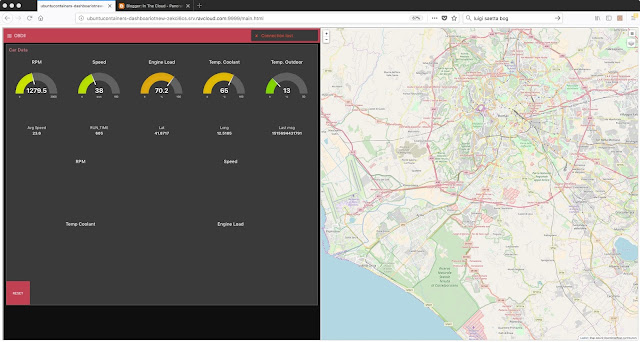
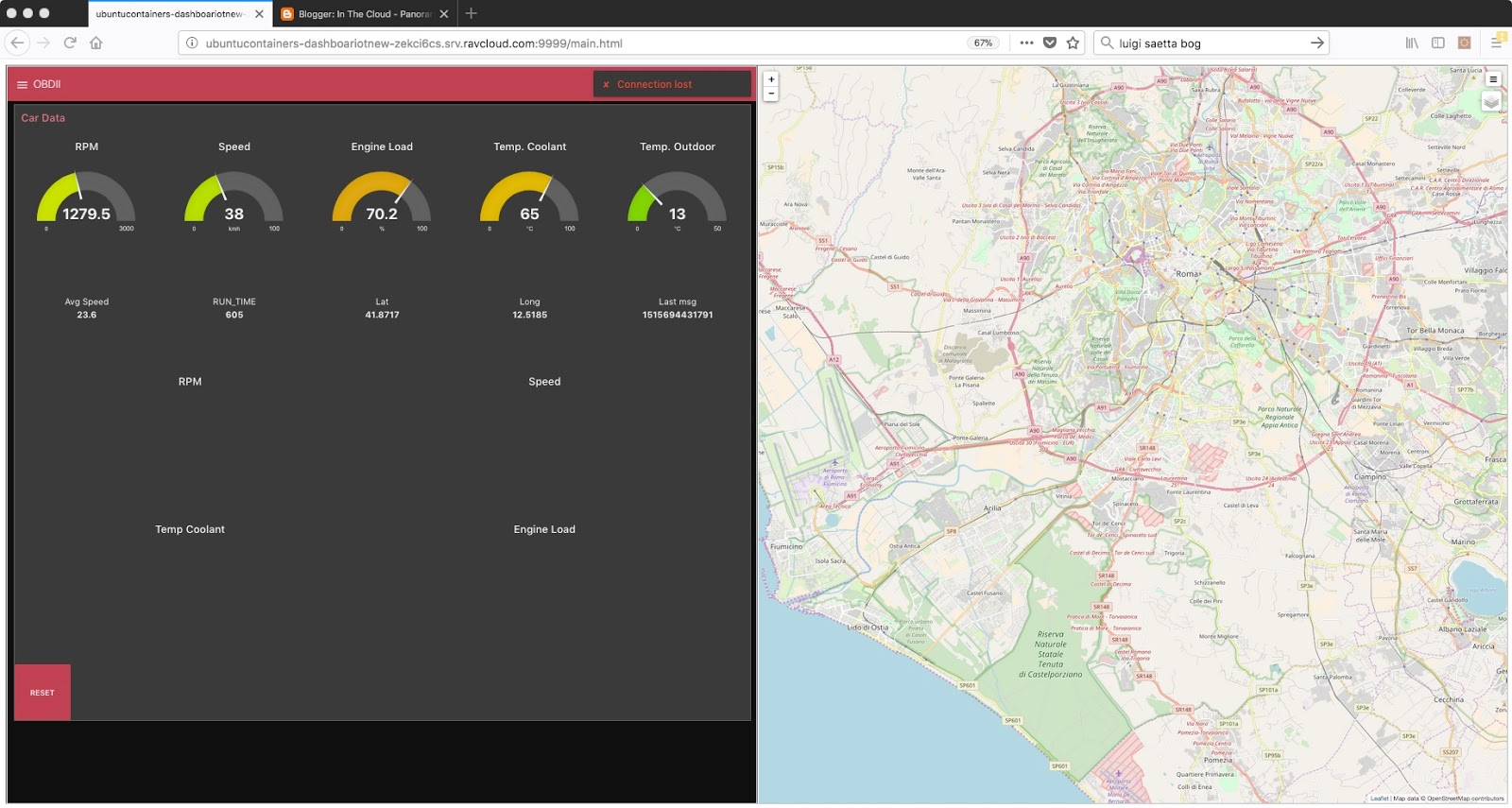
And this is a first snapshot
The Connected Car Project has a Cloud Backend.
Data coming from the gateway on the car are sent, as MQTT messages, to the IoT backend.
Behind the Message Broker there is a set of MicroServices enabling: data storage, filtering, transformation, visualization and analysis of data.
Data are visualized as a Real Time Dashboard and car's position is shown on a Map.
This is a first snaphot. Not bad.
Data coming from the gateway on the car are sent, as MQTT messages, to the IoT backend.
Behind the Message Broker there is a set of MicroServices enabling: data storage, filtering, transformation, visualization and analysis of data.
Data are visualized as a Real Time Dashboard and car's position is shown on a Map.
This is a first snaphot. Not bad.
Thursday, January 4, 2018
MY Connected Car with Google (Voice Kit)
Ok, the first test is almost on the way. I'm ready and I'll do it tomorrow morning.
It has not simply been like: copy the python code on the RPI of the Voice Kit. Because I wanted to start using at least one feature of the RPI-Voice-Enabled.: the LED of the Hat.
And therefore things soon became a little bit more complicated than I expected:
Tomorrow: test with real data from OBDII interface.
Stay tuned.. and hope to not feel too much the anxiety for tests.

It has not simply been like: copy the python code on the RPI of the Voice Kit. Because I wanted to start using at least one feature of the RPI-Voice-Enabled.: the LED of the Hat.
And therefore things soon became a little bit more complicated than I expected:
- how to setup the right environment to execute VoiceKit SDK
- and then the Python version changed from 2 (the original I used) to 3... and I hit a difference
Tomorrow: test with real data from OBDII interface.
Stay tuned.. and hope to not feel too much the anxiety for tests.
Wednesday, January 3, 2018
(MY) Connected Car Project: the Next Big Thing
Yes, solutions of the future are built as mashup. Assembling building blocks.
Some months ago I purchased the Google Voice Kit and I assembled it.
I have also used it for some demo at work. It is a very nice and cost effective way to show how you can build custom solutions using Google Assistant Technology, Speech-to-Text (STT) and Text-to-Speech (TTS).
Now, the idea is: why not to run the OBDII python code on the Google Voice AIY kit?
It should be possible and easy: we have an RPI 3, and Python SDK from Google.
Therefore, this is MY Next Big Thing: my OBDII Python Code running on this:

If you want more details, see older posts and have a look at the MY Connected Car Project
Last but not the least: my idea of playing with "cars" started from a suggestion, and work we did together, from one great collegues and friend: Fabrizio Marini. Thanks guy!
Some months ago I purchased the Google Voice Kit and I assembled it.
I have also used it for some demo at work. It is a very nice and cost effective way to show how you can build custom solutions using Google Assistant Technology, Speech-to-Text (STT) and Text-to-Speech (TTS).
Now, the idea is: why not to run the OBDII python code on the Google Voice AIY kit?
It should be possible and easy: we have an RPI 3, and Python SDK from Google.
Therefore, this is MY Next Big Thing: my OBDII Python Code running on this:

If you want more details, see older posts and have a look at the MY Connected Car Project
Last but not the least: my idea of playing with "cars" started from a suggestion, and work we did together, from one great collegues and friend: Fabrizio Marini. Thanks guy!
How technology and IoT can save lives
I'm working on a presentation on IoT and Smart Cities and, during the preparation of the material, I came across a nice article from MIT Technology Review. It is about the Boston Smart Streets and Vision Zero Programs

Have a look:
https://www.technologyreview.com/s/607975/how-a-wireless-sensor-system-in-the-busiest-city-intersections-can-save-lives/
Have a look:
https://www.technologyreview.com/s/607975/how-a-wireless-sensor-system-in-the-busiest-city-intersections-can-save-lives/
Subscribe to:
Posts (Atom)